
Should You Use a Nebulizer for Cough?
Key Highlights
- Nebulizer relieves cough by reaching deep into the airways, effectively breaking down and loosening the mucus.
- It comes in three types - Jet nebulizer, ultrasonic nebulizer, and mesh nebulizer.
- They can be preferred for all age groups from infants, and adults to the elderly population.
- They can deliver larger volumes of medications for an extended period.

Do you feel hesitant to choose a nebulizer as a cough remedy? Do you feel unsure about its effectiveness? You are not alone! There exists a dilemma regarding the use of nebulizer for cough in terms of their effectiveness. In your quest for cough remedies, understanding the role of nebulizers and busting the dilemma around it becomes important.
Let’s unravel the complexities surrounding nebulizer use and explore whether it’s a suitable option for addressing troublesome coughs.
As we delve into the considerations, benefits, and insights, you'll gain a comprehensive understanding of whether a nebulizer is the right tool to drive away your respiratory woes, let’s find the answer to that burning question – Should you use a nebulizer for cough?
What is a nebulizer?
A nebulizer is a device that transforms liquid medication into a fine mist, allowing you to inhale it into your lungs.
A nebulizer comprises a compact machine (compressor) that connects to either a mouthpiece or a facemask. The mouthpiece or facemask is equipped with a small container that holds liquid medicine. The nebulizer utilizes air to break up liquid medicine into a fine mist that can be inhaled into your lungs.
Types of nebulizers
Nebulizers come in mainly three types:
1. Jet nebulizer
Jet nebulizer is the most used nebulizer. It delivers medicines with pressurized gas in the form of an aerosol. It successfully administers medications that cannot be dispensed using inhalers.
2. Ultrasonic nebulizer
Ultrasonic nebulizers use a crystal that vibrates at high frequencies (1-3 MHz) to generate aerosols (small droplets).
3. Mesh nebulizer
Mesh nebulizers use advanced micropump technology to produce aerosols. They propel liquid medications through various openings in a mesh to create the aerosol.
You can use a nebulizer with water for cough or a hypertonic saline nebulizer to get effective relief to your airways.
Why use a nebulizer for cough?
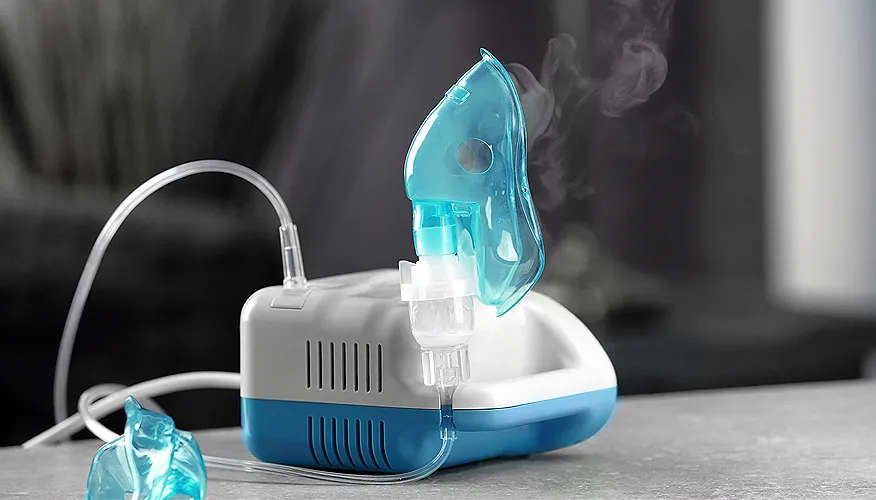
You may have opted for home remedies or over-the-counter medication for relief in case of persistent cough.
So, can a nebulizer be used for cough relief?
Research shows that using a nebulizer provides immediate relief in about 65% of individuals with chronic cough.
Using a nebulizer can assist in loosening phlegm, facilitating the rapid clearing of your airways. It is commonly used to manage conditions such as asthma, chronic obstructive pulmonary disease (COPD), and other respiratory infections.
How does a nebulizer treat a cough?
- When it comes to coughs, particularly those associated with underlying respiratory conditions, a nebulizer can provide targeted relief.
- The fine mist generated by the nebulizer allows the medication to reach deep into your airways, helping to break down and loosen the mucus.
- This makes coughing more productive, aiding in the removal of phlegm and clearing the airways.
Whether you’re dealing with a persistent cough due to an underlying respiratory condition or a temporary illness, incorporating a nebulizer into your treatment plan as a cough remedy can be beneficial for alleviating symptoms and supporting respiratory health.
Using nebulizers for cough
Here are the general steps for using a nebulizer machine for effective relief from nagging cough in both adults and children.
- First, ensure that your hands are clean. Follow your healthcare provider's prescription to pour the prescribed nebulizer medicine for cough for children or adults into the medicine cup.
- Attach the top piece to the medicine cup and affix the mouthpiece or mask.
- Connect the tubing to the medicine cup from the compressor.
- Place the mask over your face or position the mouthpiece in your mouth between your teeth, sealing your lips tightly around it.
- Switch on the compressor.
- Keep the nebulizer upright to prevent spills and to ensure proper medication distribution.
- Inhale normally through your mouth, allowing the medicine to penetrate deep into your lungs.
- Continue this process until all the medicine has been dispensed from the cup.
What is the difference between nebulizers and inhalers?

Let’s explore the differences between nebulizers and inhalers to broaden your understanding of these medical devices:
Delivery method
- Nebulizers deliver medication in the form of a mist, which is inhaled through a mask or mouthpiece.
- Inhalers deliver medication in a pressurized aerosol form, which is typically inhaled through the mouth.
Medication form
- Nebulizers use liquid medication and convert it into a fine mist for inhalation.
- Inhalers dispense medication in a dry powder or metered dose of liquid.
Medication volume
- Nebulizers may require a larger volume of medication to produce the mist, especially for extended sessions.
- Inhalers often deliver a concentrated dose, requiring less medication per single use.
Suitability for different age groups:
- Nebulizers can be preferred for all age groups from small babies to the elderly who may find the use of inhalers challenging.
- Inhalers are suitable for only those individuals who can comprehend and coordinate the inhalation process effectively.
Maintaining and cleaning the nebulizers
Maintaining the cleanliness of your nebulizer is crucial to preventing the spread of germs and ensuring its optimal function.
It is advisable to clean the nebulizer components including the mouthpiece or mask, top piece, and medicine cup after each use.
Care after each treatment
- Begin by disassembling the nebulizer, removing the tubing (which should never be submerged), and setting it aside.
- Take apart the mouthpiece or mask, top piece, and medicine cup. Place them on the top shelf of the dishwasher or wash them in warm soapy water.
- Rinse thoroughly, shake off excess water, and allow the components to air-dry in a cool, dry place until the next use.
- Perform a thorough cleaning once a week by soaking the mouthpiece or mask, top piece, and medicine cup in a solution of white vinegar and water for 30 minutes or as advised by your device manufacturer.
- After soaking, rinse and air-dry the components.
- Clean the compressor's surface and the exterior of the tubing with a soapy cloth or disinfectant wipe, ensuring the compressor and tubing are never submerged in water.
Once a week care
- Disinfect nebulizer components as per the manufacturer’s instructions to eliminate germs.
- Do not wash or boil the tubing.
- Air dry the parts on a paper towel.
Care between uses
- Keep nebulizer parts in a dry, clean plastic storage bag.
- In the case of shared nebulizers, use separate labeled bags for each person's medicine cup, mouthpiece/mask, and tubing to prevent germ spread.
- Wipe surfaces with a clean, damp cloth.
- Cover the nebulizer machine with a clean, dry cloth and store it as per the manufacturer’s instructions.
- Replace medicine cup, mouthpiece, mask, tubing, filter, and other parts according to instructions or when they show signs of wear or damage.
Conclusion
The use of a nebulizer for cough is a valuable and effective option. Through this exploration, we've uncovered the fundamental aspects of nebulizers, from their types and functionality to their role in providing relief in respiratory conditions.
Nebulizers offer a targeted approach, delivering medication in the form of a fine mist deep into the airways, aiding in the breakdown of mucus, and making it easier to cough it out.
Whether you are grappling with a chronic respiratory condition or dealing with a temporary cough, the versatility of nebulizers is evident due to their ability to provide immediate relief for a significant proportion of individuals. As a reliable tool in respiratory care, nebulizers enable a more comprehensive approach to managing respiratory health, thereby ensuring healthier lives.
Frequently Asked Questions
Yes. Nebulizers can help in bronchitis treatment. However, it is essential to take the doctor's advice on the dosage while using it.
While nebulizers are generally safe, they may cause some side effects like cough, vocal hoarseness, wheeze, and chest tightness.
Yes. A prescription is needed to use a nebulizer, as it involves the use of medication. It's advisable to consult with a healthcare professional for guidance on acquiring and using a nebulizer.
You can use a nebulizer with water or hypertonic saline to get effective relief for your cough.
The choice of the best nebulizer for cough depends on individual needs and preferences. Consult with your healthcare provider to determine the most suitable option.
Yes. There is no evidence of any harmful effects on pregnancy. It's advisable to consult with a healthcare professional for guidance on using a nebulizer during pregnancy.
The frequency of nebulizer use depends on the prescribed treatment plan provided by your healthcare professional. Always follow their recommendations for effective and safe usage.
Keep the nebulizer upright to prevent spills and to ensure proper medication distribution. Inhale normally through your mouth, allowing the medicine to penetrate deep into your lungs.
A nebulizer treatment is typically recommended as a part of a treatment plan prescribed by a healthcare professional.

Dr. Pakanich Maria Petrivna
Dr. Pakanich Maria Petrivna graduated from Ukraine's Uzhhorod National Medical University, Faculty of Medicine, in 1999. She further pursued her post graduation studies at Lviv National Medical University between 1999-2000. She then spent 16 years (2000-2016) at the same university as the resident doctor neurologist. Since 2016,Dr. Pakanich Maria Petrivna has been associated as a medical representative with Mega We Care.
Did you like our Article?
Excited
0
Happy
0
Not Sure
0
Silly
0
Our team of experts frequently monitors developments in the health and wellness field, and we update our articles when new information becomes available.
Current Version
May, 31 2024
Written By
Dr. Pakanich Maria Petrivna
May, 17 2024
Written By
Dr. Pakanich Maria Petrivna


Leave a Comment